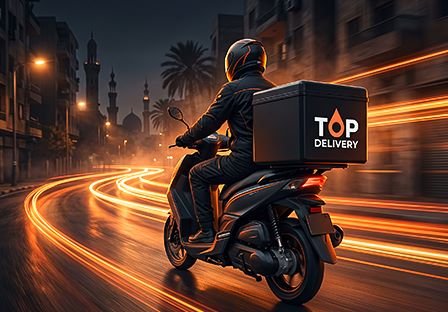
A delivery courier picks up an order from a restaurant or store and delivers it to a customer inside a defined area, working either by motorcycle or by bicycle depending on the opportunity and the city. At Top Delivery, the rate published in the income calculator is EGP 40 per hour, payouts are weekly and regular, the average time to start work is 2.1 days from applying, and applying itself is free.
| Item | Published figure |
|---|---|
| Hourly rate | EGP 40 |
| Typical day at 8 hours | EGP 320 |
| Payout cycle | Weekly and regular |
| Average time to start work | 2.1 days from applying |
| Application fee | None |
| Active captains | More than 3,000 |
| Announced cities | Cairo and Alexandria |
What a Delivery Courier Actually Does
Courier work is not simply moving an order from one place to another. There is a full cycle that repeats dozens of times a day: signing in to the platform app, receiving the order for your area, reaching the restaurant or store, checking the order is complete and correct, delivering it to the customer, and closing the order in the app.
What separates one captain from another is not speed alone. Shift discipline, courteous handling of customers, and reporting a problem quickly when something goes wrong on the road are what keep the on-time delivery rate high. That rate then shapes the opportunities offered to you afterwards, because platforms assess performance continuously.
Delivery Courier Versus Freight Driver
People confuse the two constantly, and it lands them in work they were not expecting. A delivery courier handles orders inside the city, short repeated distances, with the shift concentrated around peak hours. A freight driver handles parcels over longer distances on an entirely different schedule, usually with a larger vehicle.
Top Delivery supplies captains and manages their operations on behalf of delivery platforms. The work offered to you is platform orders, not parcel freight between governorates.
This distinction matters when you compare adverts. A listing that says “freight courier wanted” is usually different work with different vehicle and hour requirements. Read the nature of the job carefully before applying so you do not spend weeks on the wrong track.
The Supervisor and the Operations Team
You are not alone on the street. There is a supervisor and a clear escalation path when something goes wrong: a cancelled order, a customer who does not answer, a breakdown on the road. Having someone who actually responds is one of the things captains ask about most before applying, and it is also one of the most common complaints across the market generally.
The supervisor’s role is not surveillance. It is the link between you and the platform: helping with shift allocation, stepping in when an order is disputed, tracking your performance indicators and telling you what needs fixing before it affects your opportunities. Captains who use that path instead of trying to solve everything alone save themselves both time and losses.
Requirements for Working as a Delivery Courier at Top Delivery
The core requirements are clear and not complicated: valid personal data and documents, suitable transport for the opportunity, and commitment to the shifts you agree to. The contracting team reviews your data and confirms documents and vehicle requirements during onboarding, so there are no surprises after you start.
Courier Jobs That Require a Motorcycle
Motorcycle opportunities are the most numerous. They cover longer distances and more orders per shift, which means a higher return for the same number of hours. If you have a motorcycle you will need a valid driving licence and sound vehicle papers, and that is confirmed with the contracting team before activation.
If your licence is close to expiring, or you need to obtain one from scratch, it is better to start that process in parallel with applying so it does not delay your activation.
Courier Jobs Without a Motorcycle
If you do not have a motorcycle there is still a route in. The income calculator on the captains page includes the bicycle as an option, and bicycle work runs on shorter lines inside neighbourhoods rather than long distances. That makes courier work without a motorcycle a genuine entry point for people starting out, without waiting until they can buy a machine.
The practical difference is that the number of orders per shift is lower, so the return depends more on how dense demand is in the neighbourhood you work.
Documents the Contracting Team Confirms
The document list is confirmed during onboarding according to the opportunity and the city, and the contracting team is who explains it to you precisely before activation. The important point: applying itself is free, and there are no fees of any kind to begin the hiring process.
A Day on Shift from Start to Finish
Starting the Shift and Signing In
The day begins by signing in to the platform app at the agreed time. Being on time for the start of a shift is not a formality — it is the basis on which orders are distributed and the area is covered.
Peak Hours and How to Work Around Them
Peaks in delivery fall in known windows: lunchtime, after sunset, and at the weekend. These are the periods with the highest order volume and therefore the highest return for the same hours. Captains who plan their shift around the peaks earn more than those working random hours.
On the other hand, peaks also carry the most pressure: heavier traffic, longer waits at restaurants, and a greater chance of delay. Smart planning does not mean working peaks only; it means distributing your hours so you take your share of orders without burning yourself out in the hardest window every single day.
Closing the Shift and Payouts
At the end of the shift you close orders in the app, and your hours and performance are counted. Payouts are made on a regular weekly cycle, and that is one of the clearest differences between an organised operator and work of unclear origin.
Delivery Courier Pay: The Hourly and Daily Calculation
The question captains ask most is “how much does it pay?”, and the answer published on the captains page of the Top Delivery website is clear: EGP 40 per hour in the income calculator. That is roughly EGP 320 for an eight-hour day, with weekly, regular payouts.
That figure is an estimate and varies with your hours, the area you work and how dense demand is there. The income calculator itself lets you change the number of hours and the vehicle type and see the result before you apply, which is more accurate than any general number quoted in a video or an advert.
How to Calculate Your Net Income
If you work by motorcycle, the figure above is before your own costs. Fuel, routine maintenance and your data package all come out of your pocket, so it is better to calculate net income on the basis of your actual weekly hours rather than the highest possible number.
A simple method: multiply your weekly hours by the hourly rate, then subtract expected fuel and maintenance for the week. That result is the number you can genuinely use to compare one opportunity with another.
Why General Numbers in Adverts Mislead
Most numbers quoted in recruitment videos are the best possible case: the longest hours, the densest demand, and no costs deducted. When you compare opportunities, compare on the same basis — the same hours, the same vehicle type, and after costs. The number worth deciding on is the one you worked out yourself, not the one you heard.
That is exactly why the income calculator on the site is more useful than any figure written in an advert: you change the variables yourself and see the result before you apply.
The Weekly Payout Cycle
Payouts are weekly and regular, and each platform’s details are confirmed before activation. Regular payment is what lets a captain plan their expenses, and it is a bigger reason captains stay in the work long term than any one-off incentive.
Top Delivery’s Partners: Amazon Now Egypt, Talabat Egypt and noon Minutes
Top Delivery works with major platforms including Amazon Now Egypt, Talabat Egypt and noon Minutes. That means the opportunities put in front of you are on platforms known by name, not work of unclear origin, and that there is a party responsible for your operation and your payouts under its own name.
Contracts with platforms of that size are not awarded on price alone, but on operational discipline — which comes back to the captain in the form of more orders and more orderly distribution.
Those platforms also hold clear standards for customer handling and delivery windows. A captain who gets used to those standards from day one finds the path easier, because the same discipline is what opens more opportunities inside the network later.
Cities Where Top Delivery Captains Work
Opportunities currently announced are in Cairo and Alexandria. If you are in another governorate, the better move is to submit your data and select your city in the form, and let the contracting team explain what is available for your area, rather than relying on something you read in a group or saw in a video.
The difference between one city and another is not only the rate, but demand density, distances and the nature of the traffic. Cairo has both high-demand districts and quiet ones, and Alexandria behaves differently because the city stretches along the corniche with neighbourhoods branching off it. That affects how many orders you can deliver in the same hours, so factor the area into your expected income, not just the hours.
And if you see an advert claiming there is work in a governorate not announced on the site, verify the source before you travel or pay anything.
How to Apply as a Delivery Courier at Top Delivery
- Open the captains page and calculate your expected income based on your hours and vehicle type.
- Submit your data and documents through the form on that same page.
- The contracting team reviews your data and contacts you to complete the process and confirm documents.
- After confirmation and activation, your first shift begins — the average is 2.1 days from applying.
Applying is completely free. There are no fees to apply and none to begin the hiring process, and if anyone asks you for money to “sort out” a job for you, that is not Top Delivery. This is one of the most frequently asked questions among captains, because the market contains brokers who charge for things that are not theirs to give.
Working Through an Operator Versus Directly With a Platform
This question comes up constantly, and the answer changes what you choose. When you work directly with a platform you are responsible for everything yourself: registration, documents, following up when something is disputed, and resolving any account problem. When you work through an operator, there is a party between you and the platform handling the contract, operational management and payouts under its own name.
The practical benefit for the captain is that there is someone accountable by name you can go back to. The possible drawback is that terms follow the operator’s agreement with the platform rather than your personal preference. Choosing between the two depends on what matters more to you: full independence, or support and a clear path when something goes wrong.
What matters in either case is knowing exactly which party you are contracting with, and that the name has a registered entity and a known address.
Terms You Will Meet in Delivery Work
If you are new to the field, there are words you will hear from day one. Understanding them saves you time and confusion:
- Zone: the geographic area where you receive your orders. Your zone choice affects order volume.
- Shift: the time window in which you sign in and receive orders.
- Batch: a group of orders you take together in the same direction instead of one at a time.
- On-time delivery rate: the share of orders you delivered within the set window, which affects your rating.
- Cancellation rate: the share of orders cancelled from your side, an indicator platforms track.
- Activation: the moment your account is genuinely ready to receive orders after document review.
These terms are not cosmetic — they are the language your supervisor and the platform will use with you, and your assessment is built on them.
Practical Advice for Your First Week as a Courier
Your first week sets the rhythm for everything after it. Captains who start in an organised way settle in faster.
- Start with a reasonable number of hours before increasing. Learn your real capacity instead of starting at maximum and stopping after a week.
- Plan your shift around peak hours, because they give the highest return for the same hours.
- Charge your phone before the shift and carry a power bank. The app is your entire working tool.
- Learn your zone properly: the main streets, the exits, and the areas that jam at particular times.
- Report any problem the moment it happens instead of trying to fix it alone and running late on an order.
- Track your own hours and costs from the first week so you know your real net income.
Staying Safe on the Road While Working
Delivery work happens on the road, and safety is part of the job rather than an addition to it. The basics professional riders agree on: a helmet on every shift without exception, keeping to speed limits, and no phone use while riding — pull over if you need to answer or check an address.
At night, reflective clothing and properly working lights make a real difference. And if something happens on the road, your safety comes before the order — the order has a procedure, you do not have a replacement.
How to Assess a Delivery Opportunity Before Accepting It
Before agreeing to any opportunity, there are specific questions, and if you cannot get a clear answer to them that is itself a signal:
- Which party are you contracting with by name, and does it have a registered entity and an address?
- What exactly is the rate per hour or per order, and where is it published?
- How often are payouts made, and by what method?
- Are there any fees to apply? Any request for money in exchange for a job is a red flag.
- Who is the person you go back to when something happens on the road?
A serious opportunity answers those with numbers and without evasion. If every answer is “it depends”, take your time before committing.
Frequently Asked Questions About Delivery Courier Work
How much does a delivery courier earn per hour?
The rate published in the income calculator on the captains page of the Top Delivery website is EGP 40 per hour, roughly EGP 320 for an eight-hour day. The figure is an estimate and varies with hours and area.
Can I work as a delivery courier without a motorcycle?
Yes. The income calculator includes the bicycle as an option, and bicycle work runs on shorter lines inside neighbourhoods.
Are payouts weekly or monthly?
Payouts are weekly and regular, and each platform’s details are confirmed before activation.
Is there a fee to apply?
No. Applying and beginning the hiring process are completely free.
How soon do I start work after applying?
The average time to start work is 2.1 days from applying, according to the figures published on the captains page.
What is the difference between order delivery and freight work?
Order delivery means delivering restaurant and store orders inside the city over short, repeated distances. Freight work means parcels over longer distances on a different schedule. Top Delivery supplies captains for platform orders.
About Top Delivery
Top Delivery for Order Delivery is an Egyptian company registered under commercial number 21893, based at 18 Abdel Azim Salama Street, Eighth District, Nasr City, Cairo. The company supplies captains to delivery companies and platforms and handles their hiring, onboarding and manages their operations and payouts under its own responsibility. It operates in Egypt and Kuwait, with more than 3,000 captains currently working across its network.
If this work suits you, open the captains page, calculate your expected income based on your hours and vehicle, and submit your data in minutes. Applying is free.